

AI has made creating things incredibly cheap.
Images, videos, copy, music, almost anything can now be produced in minutes.
That is great for marketers.
It is also creating a problem: slop.
The internet is filling up with content that looks polished but feels interchangeable. The same perfect people. The same cinematic lighting. The same generic copy. The same AI-generated “creativity.”
The problem is already showing up in how people respond to content. Audiences are becoming increasingly good at spotting, and increasingly willing to scroll past, generic AI-generated content. And that includes advertising. When an ad looks like it was produced by an algorithm rather than shaped by a brand with a point of view, it becomes easier to ignore. AI may have made creative production cheaper, but it hasn’t made attention any easier to earn.
And some brands are beginning to push back.
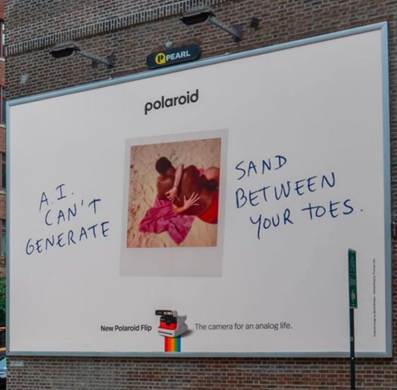
Polaroid recently ran billboards with a simple line:
“AI can’t generate sand between your toes.”
The campaign positioned its analogue camera as an antidote to digital overload, with other lines including “Real stories. Not stories & reels.”
(source: https://www.instagram.com/p/DaBN8m9lppi/?img_index=8 )
Dove has gone further, committing to never use AI to create or distort women’s images in its advertising. It has even introduced a “No Digital Distortion” mark to signal that the women shown have not been digitally altered. (source: https://www.instagram.com/reels/C6HD68JsMv4/ )
Faber put a “Human Written” stamp on Sarah Hall’s novel Helm, a deliberate signal of human authorship at a time when readers can no longer automatically assume that what they are reading was written by a person. (Source: https://www.theguardian.com/books/2025/oct/15/books-by-people-for-people-publishers-launch-certification-human-written-ai)
And the infrastructure around AI is beginning to reflect the same tension. Anthropic has introduced invisible, machine-readable watermarks in Claude’s generated text, partly in response to new EU transparency requirements. Meanwhile, AI-detection company Pangram raised $9 million in July 2026 to expand its ability to identify AI-generated text and images.
This isn’t a war on AI.
It shouldn’t be.
AI is an incredibly powerful tool, and marketers should absolutely use it where it makes sense.
The more interesting question is:
Where shouldn’t a brand use it?
That’s where “anti-slop” becomes a brand decision.
When production becomes almost limitless, production itself stops being the differentiator.
The scarce things become attention, trust, originality and meaning.
And sometimes, the fact that something was made by a person becomes part of what makes it valuable.
A real photograph carries the evidence of a moment that actually happened.
A real person brings imperfections that an algorithm might otherwise remove.
A book can now tell you that a human wrote it.
None of this means human-made is automatically better.
It means the choice to keep something human can itself become part of the brand.
For Dove, real people reinforce its entire brand proposition.
For Polaroid, real experiences reinforce what the product is for.
For Faber, human authorship reinforces the value of the craft.
The opportunity isn’t to reject AI.
It’s to decide what your brand believes should remain human.
That could become one of the most interesting brand questions of the AI era:
What will you refuse to automate?
Because when making things becomes infinitely cheap, proving that someone deliberately chose to make something, and cared enough to make it well, becomes worth paying for.
Anti-slop isn’t anti-AI.
It’s pro-intent.